Content warning: This article contains mention of suicide.
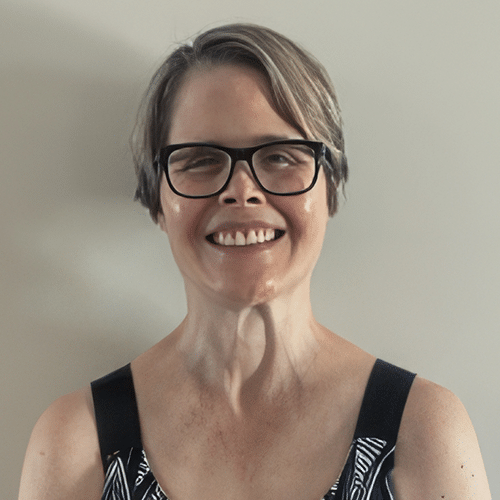
In 1994, Tessa was 16 and completing an outdoor history assignment when her hands went numb. She struggled to hold a pen, which she assumed was due to the cold July weather.
When her hands warmed up, and the tingling didn’t go away, Tessa went with her parents to see a local GP, which led to her MS diagnosis two years later.
“It was quite an isolating experience at 16 years old; to be spending my school days in the typing room and everything was a bit strange. But eventually I saw the neurologist and had a high-dose IV steroid treatment, and gradually my hands went back to normal.”
In hindsight, Tessa shared that she doesn’t recall feeling particularly stressed by those first symptoms, and once her numbness subsided, she continued with her life.
“I don’t remember being all that worried because I could still do everything I wanted to do as a 16-year-old. I was living at home; I didn’t have any responsibilities. I was just, you know, going to school and doing my thing.”
Driving is freedom
In 2007, Tessa experienced a severe relapse, which impacted the sensation in her legs.
“I was 28 years old but could hardly walk, and it wasn’t safe to drive because I couldn’t feel the pedals.”
The symptoms subsided after another round of steroid treatment, but she experienced another relapse soon after, further impacting her ability to drive.
Along with receiving support for her mental health, Tessa was recommended to learn to drive using hand controls, which helped her regain independence and autonomy.
“It was really like learning to drive all over again.”
“[Learning] was quite nerve-racking, but I’m glad I did it because it’s given me a lot of freedom over the years.”
“Growing up on a farm, I’ve known since I was young that driving is freedom. Driving is being independent.”
Despite the initial adjustment and having her car fitted with hand controls, then learning to drive all over again, Tessa was happy to regain her independence.
Flying Solo
The year she turned 30, Tessa was invited by a friend who was travelling to meet up in New Zealand, but she decided not to go because of her uncertainty about travelling alone.
“I was like, ‘Oh no, I’m definitely not comfortable with that.’”
At the time, Tessa hadn’t travelled much, but it planted the seed that led to many years of international solo travel.
Her first taste of solo travel was flying home from Thailand after a trip with a friend. This boosted her confidence in her ability to travel independently and led to trips to Bali, Singapore and the U.S.
As her confidence grew, so did the scale of her adventures.
“I loved that first trip to the US in 2013 so much that I came home and saw “round-the-world” tickets being advertised for the following year. And just went ahead and booked it.”
However, after returning from a trip to Canada over Christmas 2019, Tessa experienced her first relapse in thirteen years, leading to a period of treatment changes and adjustment.
Advocacy and Sharing lived experience
Tessa lost her father to suicide in 2006, a devastating event that led her to be very active in suicide prevention advocacy for many years.
During this time, she was given the opportunity to participate in a “lived experience storytelling” workshop through Suicide Prevention Australia. This gave her the confidence to share her story to raise awareness.
Tessa was also a founding member and later Chairperson of Stamp Out Suicide Yorke Peninsula, known locally as “SOS Yorke” and part of the SA Network of Suicide Prevention Networks.
The role gave her a platform to share her story publicly and advocate for others affected by suicide.
“That gave me the confidence in doing that and I’m finding now that I’m older and have been living with MS for over 30 years, that my experience of MS is much more central to my life.”
Which has also motivated her to join MS Australia’s Lived Experience Expert Panel (LEEP).
“All the years I’ve lived with MS, I really wanted to be able to share what I can to have others benefit from that.”
“I’ve been really grateful to have had the opportunity to be involved in a couple of research opportunities.”
Through the LEEP, Tessa has been able to share her lived experience and contribute to projects aimed at improving the lives of people living with MS.
“That’s something I really love about being part of the LEEP.”
The May 50K
After many years of not being very active due to past MS issues with her legs, Tessa adopted a Jack Russell named Boss in 2015. Knowing she’d need to walk him every day motivated her to ease herself into regular movement.
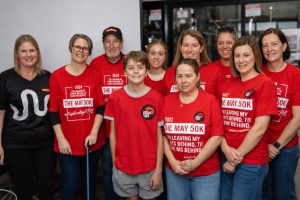
Team Arthurton
“We started out [with] 10-minute walks and gradually got up to about 4 kilometres a day over three or four walks.”
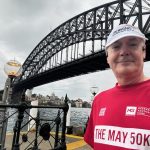
When The May 50K opened up registrations in 2019, she signed up and shared it on social media which prompted her community to join in and create a team.
“A group of friends joined me to start “Team Arthurton” (named for my hometown), and we have done the May 50K every year since – although I missed one year due to a MS flare-up.”
“In total, we have now raised over $80,000 for MS research since 2019, which is just incredible!”
Writing Flying Solo: Tessa’s life in her own words
In recent years, Tessa had the idea of sharing her life experiences and travels in a memoir but had never really got started. Then in January 2026, she saw a former colleague advertising her new business venture “The Memoir Writer” and finally, the project moved forward.
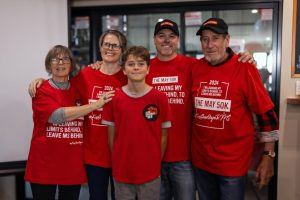
Tessa with her family at the Flying Solo launch event
While the memoir writing service was very professional and handled her story with care, after the first draft, Tessa realised her story was one that only she could write. And with over 20 years of experience as a grant writer, she felt able to take it on.
“I just felt like there was more I wanted to say, there was more detail I wanted to go into. Natalie did a fantastic job, but I also realised I wanted to put it in my own words.”
She remembers that the process of recounting her life experiences was both therapeutic and confronting.
“I did find it hard going back to some stuff, especially writing about when my dad died. But it’s all been part of my journey. And I’m glad I did it.”
“A big part of what I wanted people to get out of my memoir was that although I’ve lived with MS for over 30 years, I’ve remained very independent and had some awesome solo travel adventures. I really hope that my story inspires the more recently diagnosed and that others can relate to at least parts of my MS journey.”
Tessa’s memoir, Flying Solo is available for download, she has also set up a feedback form and would love to hear from anyone who has read her story. Especially people living with MS.
If you or someone you know is in need of support, contact Lifeline at 13 11 14 or visit www.lifeline.org.au.