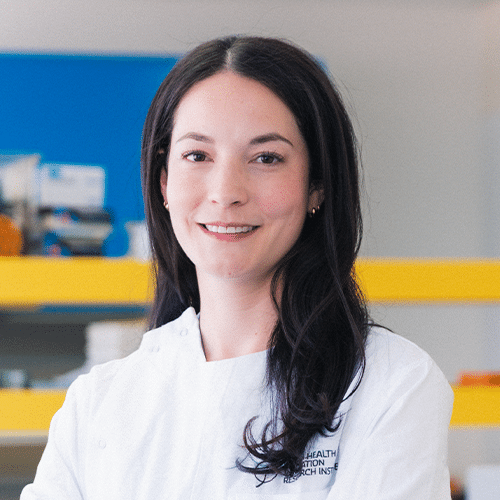
Dr Brittney Lins

Curtin University, WA

Dr Brittney Lins is a researcher at Curtin University in Western Australia. Dr Lins hopes that by understanding how and why environmental factors contribute to MS, her team can develop a toolkit to manage or even eliminate risk factors and reduce the incidence of MS for future generations.

About Dr Brittney Lins

Tell us about your current research project
I am investigating copper as an element of interest in the development of MS. Copper is a trace nutrient that we get through food, and though it is present in very low levels in the body, it plays a critical role in energy utilisation and antioxidant defences. If copper use is disrupted, myelin may be more vulnerable to inflammation and autoimmunity. I think copper could be the missing link that ties together multiple MS risk factors.
Why is your research important and how will it influence the understanding and treatment of MS?
My research seeks to determine why some people develop MS and others do not. For example, the association between MS and prior infection with Epstein-Barr virus is increasingly accepted, but only a small proportion of people with prior EBV will go on to develop MS. I hope to shed light on why this is the case, and in the process, identify new potential drug targets and lifestyle modifications to prevent MS and improve quality of life for patients.
What inspired you to get involved in MS research?
My life experience and career path converged quite naturally on MS research. I grew up in Saskatchewan, Canada, which has among the highest rates of MS in the world, so the importance of MS research has always been clear to me. As a student and postdoctoral researcher, I studied the effects of inflammation on the brain, and how glia, including oligodendrocytes, respond to brain injury. I was able to build off those experiences and leverage my skill sets to develop a new set of questions for MS and I feel very fortunate to have the opportunity to contribute to such an important cause.

What do you think has been the most exciting development in MS research?
I am really excited about the advances indicating a role for viral infection, such as Epstein-Barr virus, in the risk of developing MS. My hope is that by understanding how and why environmental factors contribute to MS, we can develop a toolkit to manage or even eliminate risk factors and reduce the incidence of disease for future generations. This also gives us vital information about new drug targets and could lead to the next treatment breakthrough.
What do you enjoy most about your research, and what are some of the challenges you face?
I feel incredibly lucky to spend my days learning and creating new knowledge. I love that a research career is multifaceted and never boring. I get to spend time hands-on in the lab; working with cutting-edge technology; and learning from creative and intelligent people. The biggest challenge is balancing all the different aspects of the job!
Tell us an interesting fact about yourself
I grew up in one of the coldest Canadian cities, routinely reaching -40°C in winter. I love downhill skiing, but my hometown is notoriously flat so I would drive to the Rocky Mountains as often as I could for the best skiing. Now, I’m trying to learn to surf in sunny Perth!
Read More

Newsletter subscription

  • This field is for validation purposes and should be left unchanged.

Brittney Lins