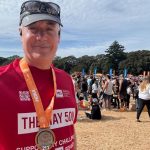
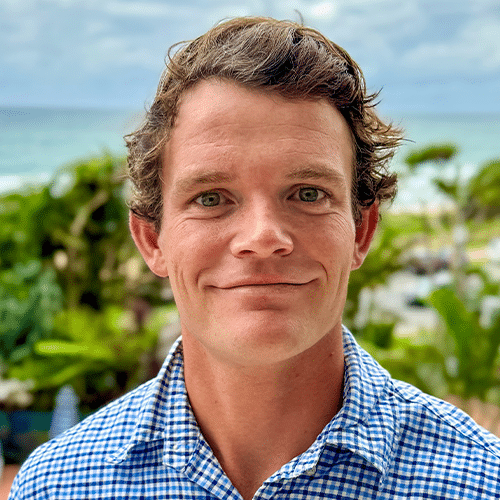
When the ground beneath you shifts, the first instinct is often to try and stand perfectly still. But I’ve learned that when life changes the conditions of the build, the only way to stay standing is to pivot with purpose.
At 25, my life was built on physical movement. I was playing AFL, surfing every day, and running businesses. When I was diagnosed with multiple sclerosis (MS), I didn’t have a plan for that. My first move wasn’t to “process” it; it was to pack my car and go camping because I thought if I didn’t say the words out loud, they wouldn’t be real. I was trying to play a finite game in an infinite reality, thinking I could win by ignoring the problem.
The turning point wasn’t a medical cure; it was a shift in perspective. My neurologist told me, “Go live your life to the fullest the way you know how. I’m not going to tell you to stop, because that is when it really starts to impact you”. He gave me my agency back. He told me that MS wasn’t the end of my story; it was just a diversion that required a more sustainable foundation.
For a long time, I couldn’t talk about it in detail with the people closest to me. I didn’t want the pity. I didn’t want to become “the sick guy” in every conversation. My mates handled it differently. No big sit-downs. No careful language. One of them, an ambulance driver, looked at my diagnosis and said, “That’s it? That’s nothing.” Another started clearing leaves off a disabled parking spot at his restaurant and said, “This one’s yours, mate.” Some people would hear that and think it’s rough. For me, it did the opposite.
It stripped the weight out of it. Put things back on level ground. It reminded me that how you talk about something shapes how it sits with you. If everything becomes heavy, it stays heavy. There’s a place for the hard conversations. And there’s a place for a laugh. You need both. My mates figured that out early. No pity, just level ground. A bit of banter, a bit of reality. It took the weight out of it and put the control back where it belongs.
Now, I approach my days with a strategy I call “Battery Management”. I still start my mornings on job sites, “on the tools” early, coordinating construction work and getting projects moving. I haven’t lost that physical part of my life, but I’ve learned that downtime is a strategic necessity, not an admission of defeat. It’s about juggling fatigue with an active lifestyle and understanding that I can’t do everything in one day, and that’s actually a win.
I’ve taken that same “tools down” mindset into the boardroom as a Non-Executive Director in the disability space. The theory matters. Strategy sets direction. But I stay focused on what actually happens when it hits the ground, because there’s usually a gap. Organisations have the right frameworks and the right language, but people are still left navigating the lived reality on their own. I sit at the table with the professional experience I have built in my career and my diagnosis, using both to close that gap and make sure intent turns into something real for people living with MS.
That same approach carries into my work with the Lived Experience Expert Panel. Whether it’s through the MS Raw Nerve podcast, advocacy, or research reviews, I keep it practical. What is working, what is not, and what needs to change. This matters even more when you look at the representation gap. Men make up roughly one in four diagnoses, and we tend to stay quiet until things are already off track. If you don’t account for that, you miss a big part of the picture.
For me, being open about this isn’t about making it heavy. It’s about setting a standard. The next 25-year-old walking out of a diagnosis needs to see that you can still lead, still contribute, and build an impactful life.
I wear my diagnosis as a badge of control now. My goal isn’t to be a “standout”; it’s just to show that you can still build a full, meaningful life while managing a chronic condition. I still reset in the ocean, surfing where there is no structure and the stresses of life can clear out. I’m not doing less; I’m just doing the same things in different spaces with a foundation that is built to last.