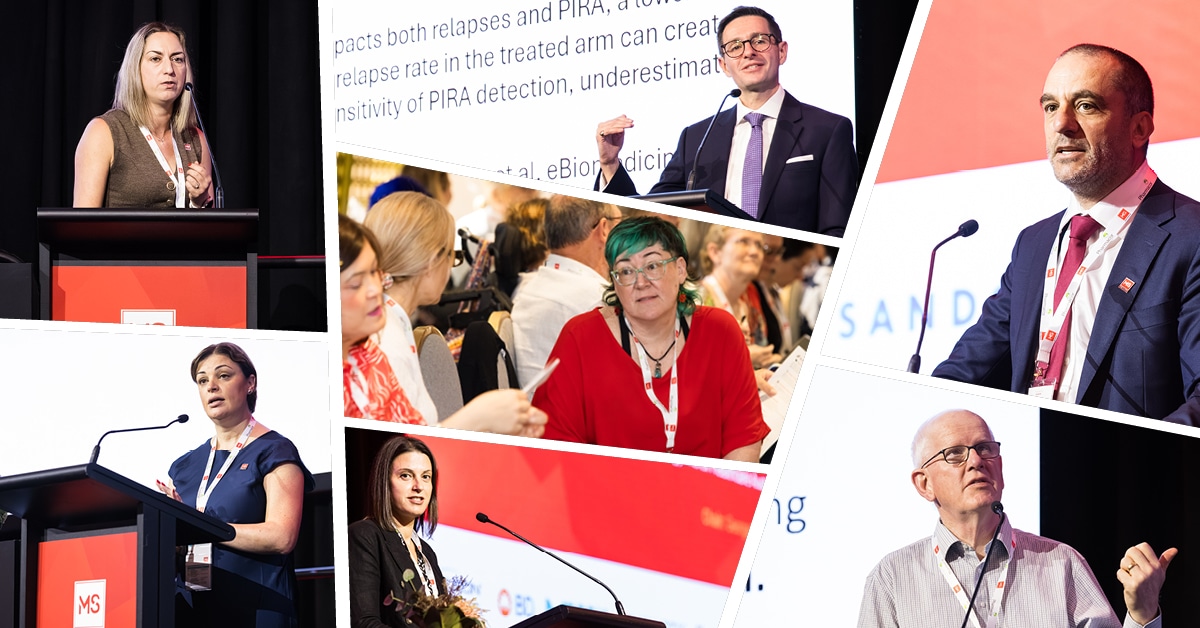
- MS Australia’s biennial Progress in MS Research Conference was recently held in Brisbane.
- More than 250 people living with MS, MS healthcare professionals and MS researchers gathered to share the latest findings in MS causes, care and cures.
- The 2025 Conference embraced the themes of MS through the ages and across the lifespan, EBV in MS, NMOSD, MOGAD and rare immunological disorders, and brain health interventions for MS.
“Progress in MS research is a team effort, not a solo endeavour” – Rohan Greenland, CEO, MS Australia
From 3 to 5 December 2025, MS community members, researchers and healthcare professionals gathered in Brisbane to discuss the latest findings in MS causes, care and cures. The biennial MS Australia Progress in MS Research Conference highlights the latest in cutting-edge research, ignites collaboration and scientific exchange, and fosters real involvement of people with MS in Australian MS research.
This year, our tenth Progress in MS Research Conference boasted over 50 scientific oral presentations, more than 80 scientific posters and more than 250 delegates. Two international and five Australian keynote speakers presented on neuromyelitis optica spectrum disorder (NMOSD), myelin oligodendrocyte glycoprotein antibody disorder (MOGAD) and rare neuroimmunological disorders, MS through the ages and across the lifespan, Epstein-Barr virus (EBV) and MS and brain health interventions.
Here are some of the highlights.
New MS Australia developments
The conference opened with the launch of two key reports to support MS Australia’s research and advocacy efforts in MS: the Multiple Sclerosis Prevalence and Health Economic Impact in Australia 2025 report and the 2025 Research and Advocacy Priorities Survey Report.
Professor Bruce Taylor from the Menzies Institute for Medical Research highlighted the new figures on MS impact: nearly 38,000 people in Australia are living with MS and MS now costs the Australian economy more than $3 billion per year. This includes the costs of treatment and loss of productivity and employment due to MS. The report also highlighted the increasing costs as disability increases, and the low quality of life reported by those living with MS, which exceeds those of metastatic prostate cancer and spinal cord injury. As a result of this report, MS Australia is calling on the government to act to improve care, access to specialist professionals, and fund MS research.
Dr Tennille Luker, Head of Research at MS Australia, noted that the top two research priorities of the Australian MS Community – including people with MS, their loved ones and carers, researchers and health professionals – are finding a cure for MS and preventing MS. The top two advocacy priorities were additional funding for MS research and approval of new MS medications.
MS Australia plays a key role in coordinating the Australia-wide MS research effort through our National Collaborative Research Platforms. The best-known of these among researchers are the AMSLS (Australian MS Longitudinal Study), PLATYPUS (Platform Adaptive Trial for remYelination and neuroProtection in mUltiple Sclerosis) and EBV in MS. The report supported the need for greater awareness of these among our wider community.
MS through the ages and MS types
Professor Daniel Ontaneda from Cleveland Clinic, US, explained how our understanding of MS disease processes has evolved over time.
Traditionally, MS was divided into disease categories – relapsing remitting MS, secondary progressive MS and primary progressive MS. MS is now starting to be viewed as a single disease that can present in different ways. People may present with relapses and progression, and progression can occur independent of relapses in all people living with MS. Understanding the biological causes of MS has changed our understanding of the disease over someone’s lifetime and is likely to ultimately affect how people are treated.
EBV – understanding the virus towards prevention and therapy
The global research effort to understand the role of Epstein-Barr virus (EBV) in MS has gained momentum following landmark discoveries in 2022, including in Australia. Professor Rajiv Khanna from QIMR Berghofer Medical Research Institute, presented on the role of EBV in MS and as a target for vaccines. EBV infection, especially during adolescence, is linked to a greatly increased risk of MS development. There is a growing interest in vaccine development for EBV in MS and trials are already underway. T cell therapies, including chimeric antigen receptor (CAR) T cell therapy, could also target EBV infection.
Researchers also presented on how the immune system controls EBV in the body, how EBV changes gene activity and how EBV could be used to predict MS onset.
MS, lifestyle, diet and environment
Professor Anne-Louise Ponsonby from the Florey Institute of Neuroscience and Mental Health discussed how lifestyle and environmental factors interact to increase the risk of MS onset across the lifespan. MS is a complex disease which means that genetics alone are not enough to precipitate MS and other environmental or behavioural factors are required.
There are a broad range of environmental factors that raise the risk of MS. These include low sunlight and vitamin D levels, tobacco smoking, adolescent obesity and EBV infection. Professor Ponsonby explained that one potential prevention approach could focus on controlling modifiable risk factors.
Other presentations covered lifestyle, diet and environmental influences, and quality of life in MS. Dietary topics included the positive effect of fasting on gut bacteria and the link between ultra-processed foods and greater disability. Physical topics included sleep quality in MS and more accurate ways to measure subtle changes in walking ability as markers of relapses and progression. Psychological and social topics included better ways to measures changes in thought processes in MS and how fatigue, thought processes, social support and presenteeism at work impact a person with MS’s views of themselves. New work was presented about geomagnetic disturbances (when solar wind interacts with the Earth’s magnetic field) and its link to MS onset.
Healthcare beyond the clinic
Ms Jodi Haartsen from Alfred Health supported the journey of brain health in MS for over 25 years as an MS Nurse and MS Nurse practitioner, and co-authored the 2024 Brain Health; Time Matters in MS Report. Jodi discussed the importance of education in MS management for brain health. This includes having a supportive ecosystem where medicine, healthcare providers and the National Disability Insurance Scheme (NDIS) are easy to access, and a person feeling psychologically safe and confident to act on healthcare decisions.
For the latest evidence-based advice on maximising brain health in MS, see MS Australia’s 2025 Living Well with MS guide.
NMOSD, MOGAD and rare neuroimmunological disorders
Professor Romain Marignier from the Neurological Hospital of Lyon, France, explained how NMOSD, MOGAD, and other neuroimmunological disorders can look like MS, and how to tell them apart. Rare neuroimmunological disorders that look like MS include chronic lymphocytic inflammation with pontine perivascular enhancement responsive to steroids (CLIPPERS), glial fibrillary acidic protein (GFAP) autoimmunity, primary angeitis of the central nervous system (PACNS), Susac syndrome, Neuro-Behçet and Neuro-Sarcoidosis. Distinguishing these disorders is important, as the wrong diagnosis can lead to the wrong treatment, which could be harmful.
Professor Fabienne Brilot-Turville from the University of Sydney, dug deeper into the methods for diagnosing and distinguishing between MOGAD and NMOSD. She explained how the MOG and aquaporin-4 (AQP4) antibodies are important for diagnosing MOGAD and NMOSD and how they can help with predicting disease activity. Universal testing standards for these antibodies was developed in Australia, but there are still issues with worldwide access to testing for these antibodies.
Global Prevention Initiative
Our Deputy CEO, Dr Julia Morahan, provided an update on the Global MS Prevention Initiative. The Initiative was launched in 2025 and MS Australia is contributing A$2.5 million over five years, in partnership with MS Canada which is contributing CAN$5 million.
Dr Morahan presented the highlights of the Global MS Prevention Workshop held in April 2025, including discussion of risk factors for MS development and disease worsening. The workshop also discussed the factors that lead to ongoing worsening of MS and what can be done with the evidence we currently have. The workshop has identified gaps that need further research which will need to be filled for MS to be prevented. Identifying accurate biomarkers and smarter use of large international registries are key. Lessons were also taken from other chronic diseases, such as type 1 diabetes, where stopping people from entering “the next worst stage” is increasingly become a reality.
Annemarie Watson Oration
As the recipient of the 2024 MS Australia Research Award, Professor Jeannette Lechner-Scott from John Hunter Hospital delivered the inaugural Annemarie Watson Oration. Annemarie Watson was a generous benefactor to MS research. Professor Lechner-Scott’s address highlighted the rising cost of research against a background of falling research spending from government. Philanthropy is becoming increasingly important in filling this gap.
Thanks to our generous donors, MS Australia has been supporting MS research for almost two decades, through our Investigator-led Grants Program, National Collaborative research platforms such as ANZgene, AusImmune and AusLong, clinical trials such as PrevANZ and PLATYPUS, and global collaborations such as the International Progressive MS Alliance.
“Donations like the one from Annemarie Watson help to keep research alive” – Professor Jeannette Lechner-Scott, John Hunter Hospital
Award-winning presentations from early-career MS researchers
The conference invites presentations by early-career researchers to provide opportunities and expert feedback for the next generation of Australian MS researchers. Attendees heard from over 50 early career researchers, including Dr Nathaniel Lizak who was awarded Best Oral Presentation for his project Long-Term Prognostic Value of Confirmed Disability Improvements in Multiple Sclerosis and Ms Meghan Hawkins who was awarded Best Poster for her project Exercise for anxiety in multiple sclerosis systematic review and meta-analysis.
Congratulations to Dr Lizak and Ms Hawkins on their achievements!
Strengthening connections for a world without MS
The tenth Progress is MS Research Conference provided a great opportunity for researchers, healthcare professionals and MS community members to share and discuss the latest findings in MS. Together, we strengthen our connections and commitments as we work towards a world without MS.
“We will leave no stone unturned, no dollar wasted, no minute spent idle, in our quest to achieve a world without MS” – Rohan Greenland, CEO, MS Australia.
The lived experience of MS is essential to MS research. The final day of the conference was a highlight for researchers, coming together with our MS community to learn and share insights. Read more about the Progress in MS Research Community Sessions.