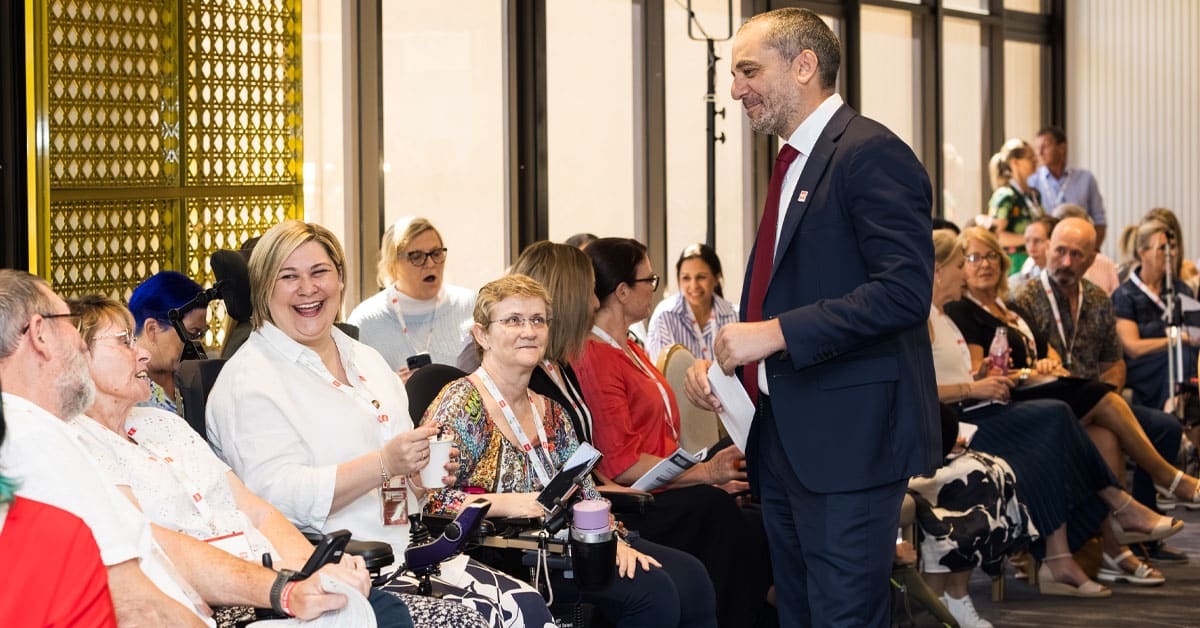
- The Community Day was a highlight of the Progress in MS Research Conference on 5th December in Brisbane.
- Lived experience was central to this event, attended by 70 delegates in person and more online.
- Researchers, clinicians and people living with MS shared their expertise towards living well with MS.
MS Australia’s tenth Progress in MS Research Conference was held from 3-5 Dec 2025 in Brisbane, exploring the themes of Causes, Care and Cures. Our Community Day welcomed 70 delegates in person including people living with MS and other neuroimmunological diseases along with their family and carers, researchers, clinicians and MS Queensland. United in our shared goal of better lives for people with MS, the connection of lived experience, research and clinical care around hope and agency was a much-loved conference highlight.
Opening addresses
MS Australia Chair, George Pampacos, welcomed Her Excellency the Honourable Dr Jeannette Young AC PSM, Governor of Queensland. Dr Young, a medical doctor and former Director of Medical Services, highlighted the impact of MS in Australia and the importance of effective services and research to create a better life for people with MS.
Rachel Kerr is a dedicated MS advocate and community leader from Rockhampton, Queensland and recipient of the 2023 John Studdy Award. Diagnosed with MS at 17, she has transformed her personal journey into a mission to support others living with MS. As an MS Queensland ambassador and member of the MS Australia Lived Experience Expert Panel (LEEP), she inspires through advocacy, fundraising, and peer support.
Rachel asked fellow LEEP members what being part of our MS Community meant to them, and what gives them hope for the future. Responses included: “Being a LEEP member helps me feel seen and understood by people who really “get it”. It gives a great sense of contributing positively and making a difference”. Of the MS community: “Their passion and determination are empowering, and being able to witness that and consider myself part of it – that gives me hope for the future.”
25 Years supporting journeys of Brain Health: Jodi Haartsen
Jodi Haartsen from Alfred Health worked as an MS Nurse Practitioner for many years. In her keynote, Brain Health: Stories, Science and Lessons from 25 Years of Walking the Journey with People Living with MS, Jodi said “MS asks a lot of you, and none of it is your fault”. She discussed “creating your best environment for a strong and capable you” and four engines that create capability.
The first is positively framing your identity: “People like me protect their brain”. Positive behaviours are more likely to stick when this identity is shared with others, because “connection is medicine”. Belonging and purpose drive motivation, improve mood and support neuroplasticity – the brain’s ability to change and adapt by forming new connections when we learn, practice, or experience something new
The second engine for capability is emotion: the feelings of hope, meaning and belonging. A calmer emotional state allows for learning and makes change possible, and it comes from people, environment and pacing. Setting up your village with support for emotional, practical, information, companionship and validation support is important. Jodi recommended the Five Ways to Wellbeing, as a handy check-in to frame daily life. It is important to activate hope and agency. Hope allows growth after trauma, and wellbeing.
The third engine for capability is ease. Jodi encouraged us all to set up life so that the healthy things are easy, and the hard things are less exhausting. Achieving a brain healthy lifestyle is not about having enough willpower but about designing your life around it. She encouraged thinking of your environment as your treatment partner – and getting it to do the heavy lifting, not your brain!
Setting up the environment also conserves the fourth engine of capability: energy. Jodi encouraged fatigue-aware planning and conserving cognitive bandwidth. Get the environment to do the remembering for you, create “high-” and “low-energy” times of day, build a “recovery environment” that you can access quickly, and save cognitive load by simplifying your choices.
Finally, Jodi encouraged self-care. “Difficult feelings often travel in packs: When fear and loss turn up, they often bring guilt, shame and disconnection.” Remember the self-care basics: sleep, eat, breathe and move. Don’t feel guilty about fatigue, needing help, saying no, brain fog, needing rest, or needing scaffolding more than motivation.
Research updates for the community
Dr Maya Panisset, a physiotherapist and researcher, explained how early intervention in MS prevents disability, but current tests for progression of MS can be unreliable and insensitive. Her research shows that wearable sensors can detect subtle brain changes in people with MS with low levels of disability, from balance and walking tests.
Dr Alice Saul’s research into types of pain has discovered that pain clusters into six different groups in MS. This may explain conflicting pain research in MS previously, and ultimately inform new ways to tackle pain in MS.
PhD candidate Marie Amigo has identified sensory tests (hot and cold sensitivity), as well as proteins in the blood, that are associated with MS relapses and detectable prior to the relapse. These could potentially be used to help track and predict relapses.
Karen Zoszak, an accredited practicing dietitian and PhD candidate, developed a new tool to track how closely people with MS follow the Australian Dietary Guidelines, which are currently recommended for people with MS by Australian MS organisations. Of 744 people with MS screened, 2.3% adhered to the guidelines for vegetable intake, while 37.4% adhered to guidelines for intake of meat/meat alternatives. These results are not dissimilar to findings in the general population, where most Australians do not meet the Australian Dietary Guidelines. The team is working on simple and practical changes to diet to support gut, brain, bone and muscle health in people with MS.
Professor Denise Doolan has developed a blood test for MS based on detecting the immune response to the Epstein-Barr virus (EBV). The test is sensitive and specific for MS and is currently in the validation stage using wider groups of samples from Australian and overseas collaborators.
Physiotherapist Associate Professor Yvonne Learmonth discussed how beneficial exercise is for MS: improving brain health and cognition; mobility and cardiovascular fitness; reducing fatigue, depression, anxiety and pain; and improving sleep and quality of life. She has developed a training program to help healthcare professionals prescribe exercise for people with MS, including using telehealth. This gave them greater confidence and helped them use behaviour changes strategies.
My story with NMOSD: Debbie Leticq
Neuromyelitis Optica Spectrum Disorder (NMOSD) is a rare demyelinating condition that was historically often misdiagnosed as MS. When Debbie Leticq was diagnosed with NMOSD in 2012, she was an active, and healthy mother, teacher and a volunteer fire-fighter.
There was little information about NMOSD available, and no patient support group to turn to for help. Debbie shared how she was fortunate to find a community on Facebook and connected to some passionate and committed specialists who helped her find her way to her new normal. Debbie is a driving force in the NMOSD community, organising the first NMOSD patient symposium in 2017 and connecting with others living with this rare, neuroimmune condition.
Despite her diagnoses, Debbie is a born adventurer, and she spoke about her many solo trips around Australia, and recording the “NMOSD Your Way” Podcast from her caravan while visiting many of her NMOSD connections across Australia, before returning home to become a grandmother.
Continence Management in MS
Jade Nolan from BD discussed a new innovation in continence management, while Jenny Zobec from Continence Health Australia discussed supports available including their free online resources, the National Public Toilet Map, and the Bins for Blokes initiative to provide bins for continence products.
MS Queensland: Together, we will
In a heartfelt address, CEO of MS Queensland, David Curd, described the connection and selfless efforts of the Queensland MS community working together to improve the lives of people with MS. David thanked the Miles Family, winners of this year’s John Studdy Award for their years of tireless work, uniting their community to raise much-needed funds for MS research and services.
Tom Crouch, Senior Allied Health Practitioner from MS Queensland, spoke about the importance of exercise for people with MS – “after disease-modifying therapies, exercise is the next most effective treatment for MS”. There are significant barriers to exercise for many people with MS, and an allied health practitioner can provide strategies to help make exercise accessible for everyone.
Tania Austen lives with MS and discussed the importance of this support from Tom at MS Queensland. Through the support of generous donors, MS Queensland’s Neuro Wellness Hub provides a welcoming environment and world-class facilities to maximise wellbeing of all people with MS and other neurological diseases, regardless of disability.
Panel Discussion: MS Symptom Management and Mental Health
Jodi Haartsen chaired an insightful discussion with Rachel Kerr; Dr Sally Shaw, a clinical psychologist who lives with MS; MS neurologist Dr Zara Ioannides; and MS Nurse Practitioner Tim O’Maley on symptom management and mental health. The panel explored the emotional impact of diagnosis, strategies for coping, and practical approaches to managing symptoms.
Sally discussed how an MS diagnosis brings shock, and the initial response can be one of overwhelm and defeat. Often, this can be followed by a determination that the person will beat MS and not let it get the better of them. Sally encouraged a moderate approach: “I am a person who manages my MS well”. A video of the complete panel session is available as a special episode of the Raw Nerve podcast.
Stronger together
The Progress in MS Research Conference Community Day was an uplifting and inspiring opportunity for diverse members of our MS community to come together and share expertise towards living well with MS. We thank the researchers, clinicians and people with lived experience for their support for this important highlight of our national MS calendar.