
- Being diagnosed with MS has a large impact on Australians’ decisions on having children.
- While many Australians with MS received or looked for information on family planning, there were also many who did not receive information, even though family planning was relevant to them.
- Australians with MS found discussions with MS specialists, the internet and written resources were the most useful ways to obtain information about family planning.
People with MS are often diagnosed at an age where they may have started a family or are thinking about starting a family. Previously, MS Australia-supported researchers had qualitatively studied family planning issues in MS. They had interviewed women living with MS about their experiences with pregnancy, fertility and family planning, and neurologists and MS nurses about their approaches to managing family planning and the resources available.
But until now, not much was known about how widely MS affects people’s family planning decisions in Australia, where they obtained family planning information and how they preferred to obtain that information.
What did the researchers do?
MS Australia-supported researchers analysed survey data from the Australian MS Longitudinal Study (AMSLS) from 270 people with MS aged 18-50 years (236 women and 34 men) about reproductive health, information they had obtained or searched for on a range of family planning topics, and how to improve their family planning experience. Family planning topics included contraception, the impact of MS on pregnancy and fertility, the impact of pregnancy on MS, and the safety of disease modifying therapies (DMTs) on fertility, pregnancy, breastfeeding and the unborn baby.
What the researchers found
Published in the journal Disability and Rehabilitation, the study found that two-thirds of women and just over half of the men surveyed had children. Of the people with children, about half said they had their children after being diagnosed with MS while 13% said they had their children both before and after their diagnoses.
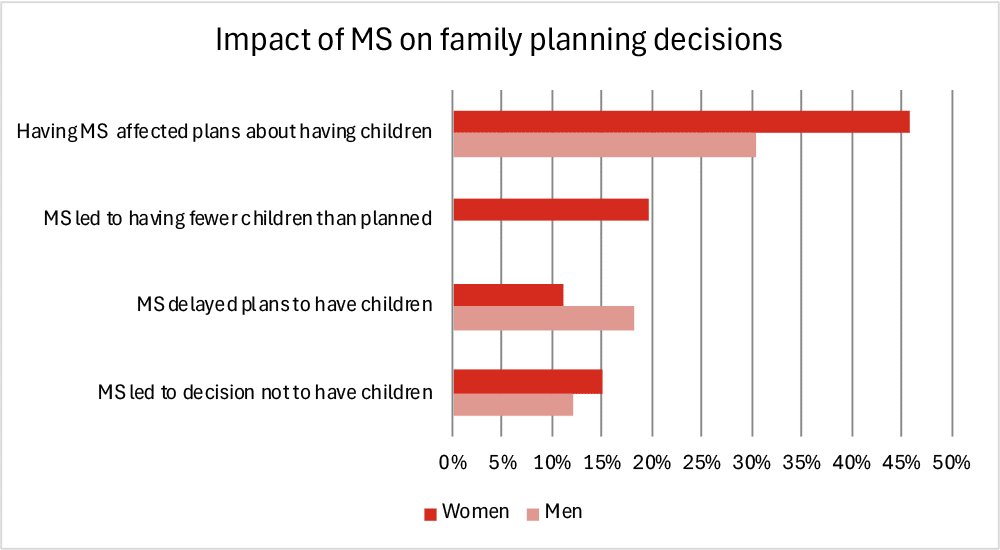
Having MS had a big impact on people’s family planning decisions, with nearly half of the women and almost a third of the men surveyed said MS affected their plans:
- 20% of women surveyed said being diagnosed with MS led them to have fewer children than they originally planned to.
- 11% of women and 18% of men surveyed said being diagnosed MS delayed their plans to have children, although it did not change how many children they decided to have.
- 15% of women and 12% of men said that being diagnosed with MS made them decide not to have any children.
Which family planning topics were the most relevant?
The majority of women said that most of the topics in family planning were relevant to them at some point after their MS diagnosis. About two-thirds said the impact of pregnancy on the progression of MS, the impact of MS on pregnancy and the safety of using DMTs were relevant to them and that they have received information on. However, the impact of MS on fertility, contraception and the safety of DMTs on fertility were the topics most frequently endorsed by women as relevant but for which they had not received or looked for information.
For men, the impact of MS on fertility was the most common topic on which they received or sought information (43%). A small proportion said family planning topics were relevant to them but they had not looked for information about them.
What were the most useful ways to receive information?
Neurologists were the most common source for family planning information for both men and women across all topics. This was mostly followed by the internet, although for women, GPs were the second-most common information source for contraception.
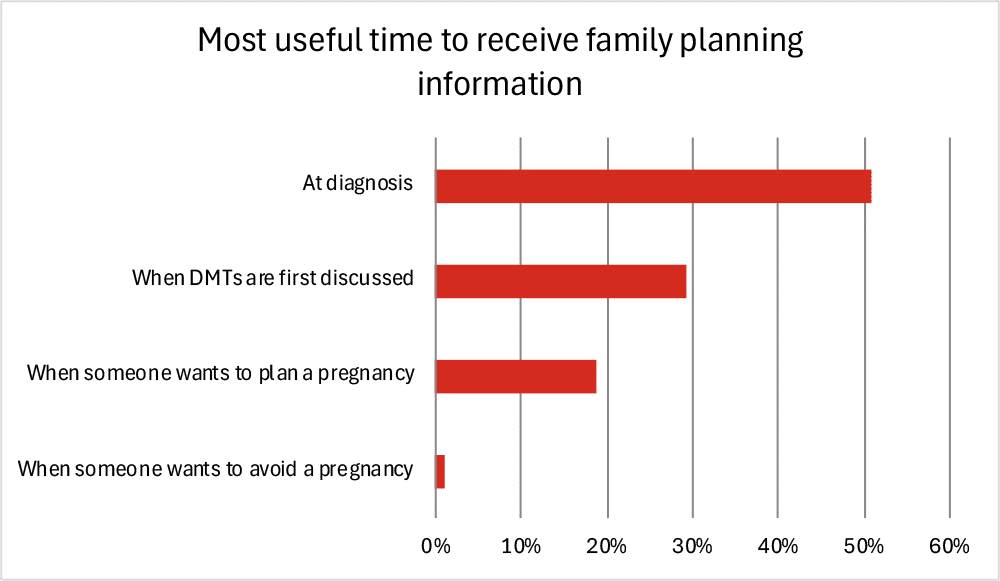
About half of the respondents said that discussions about family planning with a healthcare professional should first occur when a person is diagnosed with MS. Just over a quarter said that family planning discussions should first occur when DMTs are being discussed. About a fifth said family planning discussions should first occur when someone wants to plan a pregnancy while only 1.1% said it should occur when someone wants to avoid a pregnancy.
Respondents viewed discussing with MS specialists such as neurologists or MS nurses as the most useful way to obtain family planning information (84.7%). This was followed by information on websites (62.7%), written information such as pamphlets (65.1%) and decision aid tools (50.7%). Videos, peer support groups, email updates, and MS organisation newsletters were seen as the least useful methods.
What does this mean for people with MS?
Speaking with MS specialists, the internet and written information were seen as the most useful ways of obtaining information about family planning. Australians with MS also preferred having discussions with healthcare professionals early, at the time they are diagnosed or when DMTs are discussed.
Australians with MS, particularly women, are interested in family planning issues but a substantial proportion do not receive or seek information, even when the topics were relevant to them. As being diagnosed with MS has a big impact on people’s decisions to have children and when, people with MS may want to discuss their family planning concerns with their neurologist or other healthcare professional.
Given that discussions with MS specialists, written information and websites were rated as the most useful ways to access family planning information, these channels could be prioritised when developing and delivering evidence-based resources.