- MS Nurses Australasia provides education and support for MS Nurses and other healthcare professionals in Australia and New Zealand
- Their 27th Annual conference in Sydney featured the latest in brain imaging, emerging therapies, relapse and symptom management, case studies, research methods in the AI era and more
- Video resources Back on Track and Foundations of MS Nursing, launched in 2026 with MS Australia, have attracted over 1000 registrants internationally.

Back on Track and Foundations of MS Nursing featured at MSNA Conference 2026
The 27th Annual Conference of MS Nurses Australasia (MSNA) was held in Sydney from 13-15th August 2026 with the theme “The Roaring Twenties: a new era of opportunity”. The conference featuring the latest in imaging, emerging therapies, relapse and symptom management, case studies, research methods in the artificial intelligence (AI) era and more, providing an excellent forum for sharing specialist MS nursing expertise across Australia and New Zealand. MS Nurses celebrated the success of new video resources, Back on Track and Foundations of MS Nursing, released in 2026 in collaboration with MS Australia and already accessed by over a thousand users.
MS Nurses Australasia – supporting best quality MS care in Australia and New Zealand
MS Nurses Australasia provides education and support for MS Nurses and other healthcare professionals in Australia and New Zealand. The 2022 MS Nurse Care in Australia report found that access to MS nursing improves symptoms, disability and quality of life for people with MS. Australasian MS Nurses are renowned globally, recognised by the International Organisation of MS Nursing’s award for International MS Nurse Leadership to MSNA members Belinda Bardsley in 2026 and Dr Therese Burke in 2025; and the 2026 “Thumbs-up Award” to MSNA in 2026, for advocating and promoting MS nursing.
Selected MSNA Conference highlights
The diverse conference program included presentations from experts in MS neurology, neuroimmunology, allied health, MS Nursing, men’s and women’s health and researchers, a selection of which are below.
Professor Michael Barnett from the Brain and Mind Centre, University of Sydney, discussed how magnetic resonance imaging (MRI) is being developed to better monitor and understand progression of MS. Radiologists are very skilled at detecting new MS lesions on MRI, but it can be difficult to detect subtle changes in the size of lesions from scan to scan. The team is using AI to help detect brain and spinal cord lesions that are slowly becoming larger over time and are linked to progression of disability. Their recent study showed that therapy with anti-CD20 monoclonal antibody treatments (such as ocrelizumab) slows this expansion of MS lesions in the brain.
Associate Professor John Parratt from Royal North Shore Hospital, Sydney, provided education on how to identify MS relapses, their relationship to changes on MRI, and best clinical management. A relapse is a new neurological symptom that can be attributed to MS, lasting more than a day, associated with an objective clinical or MRI finding, and without fever or systemic illness. It is important to distinguish a true relapse from a ‘pseudo-relapse’, when a physical stress from illness or heat can result in temporary appearance of neurological symptoms.
Dr Sama Balasubramanian from Sydney Men’s Health spoke about sexual dysfunction in men with MS. This can occur early in MS and affects 50-90% of men (and 40-80% of women). Broadly, MS can affect sexual function in three ways. There can be a direct impact on neurological functions controlling factors including sensation, erection, orgasm and more. Sexual function can also be impacted secondary to other MS symptoms such as pain, fatigue, or muscle weakness. Finally, there can be psychosocial impacts of MS such as anxiety, altered body image or changing sexual identity/role.
However, sexual dysfunction in people with MS is not necessarily related to MS – it can be caused by other conditions, medications or lifestyle factors. Sexual function is impacted by psychological, biological and societal/cultural factors and assessment of difficulties should address all of these. Importantly, treatment is available and can be of great benefit for men with MS and their partners.
Dr Jennifer Massey from St Vincent’s Hospital, Sydney, helps run one of Australia’s observational trials on autologous haematopoietic stem cell transplant (AHSCT). You can read more about AHSCT here. Importantly, AHSCT is not a cure for MS, and it is important to maintain continued support from a healthcare team after this treatment, including if it has been accessed overseas.
Another emerging area of MS research discussed at by Dr Massey was CAR (chimeric antigen receptor)-T cell therapy. This treatment involves modifying a person’s own white blood cells (T cells) so they can target specific cells involved in disease. While CAR-T cell therapies are already used for some cancers, their use in MS is still being investigated in clinical trials. For MS, the target of CAR-T cell therapy is B cells, similar to anti-CD20 therapies such as ocrelizumab (Ocrevus), ofatumumab (Kesimpta) and ublituximab (Briumvi).
Researchers are investigating both laboratory-manufactured CAR-T cells and newer approaches that deliver genetic instructions directly to immune cells within the body. More than ten clinical trials are currently underway internationally, most of them early-phase studies designed to assess safety and tolerability.
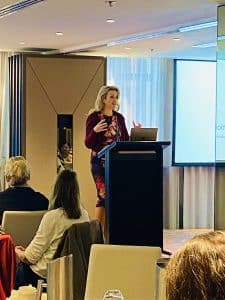
MSNA President Meaghan Osborne discusses the importance of family planning with MS
MSNA President Meaghan Osborne shared the latest on family planning for people with MS. In her role as an MS Nurse practitioner, Meaghan strongly encourages regular discussion of family planning, from new MS diagnosis onwards. As she noted, around 40-50% of pregnancies in Australia are unplanned, highlighting the importance of discussing family planning early. Careful planning and sequencing of disease-modifying therapies around pregnancy, breastfeeding, and the post-delivery period are important to optimise safety for baby and MS management for mum.
Dee Lucey is an MS Nurse from MSWA. Dee’s award-winning poster presentation highlighted a new after-hours neurological nursing service for Western Australia, called NeuroConnect. This service provides specialist neurological nurse care from 7pm-7am. It supports safe clinical decision-making and allows clients and carers to remain safely at home where possible. Recent examples of urgent overnight care included replacement of a blocked catheter and a blocked feeding tube that was essential for administering medication. Both NeuroConnect nurse home visits achieved faster support and prevented overnight hospital visits.
Video Courses: Back on Track and Foundations of MS Nursing
MSNA in collaboration with MS Australia launched two new video resources in May 2026 to support people with MS and MS Nurses. These were designed by MS Nurse Dr Therese Burke, who described them as for a gift from MS Nurses to the broader MS community.
Back on Track is a practical, hands-on guide for people with MS to live their best life. The four-part series has been developed by expert MS Nurses, based on lived experience from their combined 100 years of working in MS, and lived experience contributions from the MS community. Since its launch on World MS Day in 2026, Back on Track has been accessed by over 1600 users and shared internationally by the MS International Federation and ECTRIMS.
Launched on International Nurses Day 2026, Foundations of MS Nursing, is an introductory program designed for new MS Nurses, nurses working in related areas (outpatients, neurology, infusion clinics) and other related healthcare professionals. Already, 59 professionals have registered with excellent feedback. One registrant said, “Thank you for allowing me to complete this course. It truly has been of great value. I have already recommended the course to my colleagues who weren’t aware of it. What a wonderful resource to have.”
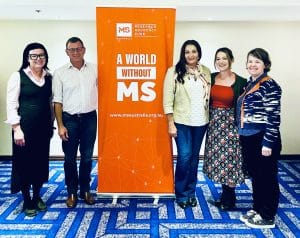
Members of MS Australia’s MS Nurses Working Group at MSNA conference 2026
What does this mean for people with MS?
Thanks to the work of MSNA, many people with MS in Australia and New Zealand enjoy an exceptional standard of MS Nurse care. However, the MS Care in Australia 2022 report showed that more than 30% of Australians with MS do not have access to an MS Nurse. MS Australia’s MS Nurses Working Group continues to work with MSNA and our State and Territory MS organisations to advocate to government for access to MS Nurses for all Australians living with MS.