
In hindsight, Carol shared that she had been experiencing symptoms of MS since her teenage years, but nothing that raised alarm bells. The symptoms that led to her diagnosis began in February of 1998 at a National swimming competition in Hobart.
“It was just shocking. And even though I felt like I was really fit, I swam like a rock. I just thought I had the flu coming on.”
As her fatigue and balance worsened, Carol’s doctor diagnosed and treated her for an inner ear infection, but when she started to have trouble with her vision, a local optometrist flagged MS as a possible explanation.
The morning of her first appointment with a neurologist, Carol felt like a fraud. Overnight, the symptoms she had been living with for months disappeared. When she entered the neurologist’s office, she assumed she was wasting his time, and his cold demeanour confirmed her worries, or so she thought.
“He wouldn’t look at me. And he said, ‘Well, you’ve got too many lesions on your brain for someone your age; you’ve got multiple sclerosis.’
And then he went on to say, ‘Your life as you know it’s over. I’d suggest you go home and put your affairs in order before you become incapacitated.’”
“To this day I don’t remember driving home. I don’t remember opening our big double gate doors to park. The next thing I remember is sitting on the couch in tears, and our six-month-old puppy jumped onto my lap, and she just started to whimper, and that kind of snapped me out of it.”
Carol reflects that it took about six months to come to terms with her diagnosis and over a year to realise that her MS didn’t define her. Over time, the inevitabilities the neurologist listed were disproven.
“I was told I couldn’t do sport anymore. He told me I’d have to quit work and go on a whole bunch of drugs. I had a great boss at the time, so I didn’t have to quit work. I even got promoted in that time! I was doing what I could, but I thought, ‘there’s no way I’m going to stop exercising,’ and I honestly believe that exercise is what’s kept me walking.”
After the shock of diagnosis wore off, Carol decided to move forward with her life, remaining active and advocating for herself to health professionals. While she was in hospital recovering from a relapse and surgery, her second neurologist visited to tell her that he suspected she had moved into secondary progressive MS.
“He was trying to tell me something but not using the right words.”
She was left in tears because he struggled to be direct with her. When her surgeon came to check in on her, she told him what had happened, and he urged her to be forthright with the neurologist about the emotional impact of his indirect communication.
“He went and got an A4 piece of paper and a pen. And he said, ‘I want you to write down exactly how you’re feeling right now. And the next time you see him’, he says, ‘I want you to read it to him.’”
“So, the next time I saw him [the neurologist], I said, ‘Sit down, shut up. I got something to say.’ And I read to him exactly how he left me that day and how I was feeling. He looked like he’d physically been hit.
I said to him, ‘I know what you’re trying to tell me. Say exactly what you mean.’ And it took him five minutes to actually get it out.
“I said, ‘See, I’m not on the floor in a heap. If you want to talk to me, talk to me like an adult. Use the proper terminology. And if I don’t understand anything going forward, I will ask.’ And it changed the whole trajectory of our relationship. And I think as people living with MS or any condition, we need to take charge.”
Since her diagnosis, Carol has strengthened her own voice and become a strong self-advocate. She later joined MS Australia’s Lived Experience Expert Program (LEEP), contributing her lived experience to a range of projects, from research to resources for people living with MS.
“I wanted to be a part of the LEEP because I want the patient to understand that you have the right to speak up. You have the right to understand what’s going on in your own body, and you have the right to discuss it at a one-on-one level with a doctor.”
“The more I can help, especially people who are just coming on this journey, the better because life doesn’t end with a diagnosis.”
For Carol, life after an MS diagnosis has opened doors far beyond what she was once told to expect. During a classroom visit after her gold medal-winning Paralympic debut in London, a Year 4 student asked a question that prompted her to reflect on all she had experienced since.
“If you could turn back the clock and not be diagnosed with MS, would you?”
“I said, ‘You know what? Nobody’s ever asked me that.’ And I looked at her, and I said, ‘No, I wouldn’t.’
Yes, I’d like a cure for MS, that would be fabulous. But MS has given me opportunities that I never would have had if I hadn’t been diagnosed with MS.
I said, ‘I wouldn’t be standing here talking to you, I wouldn’t have gone to the Paralympic Games – now three – and I wouldn’t have travelled the world.’”
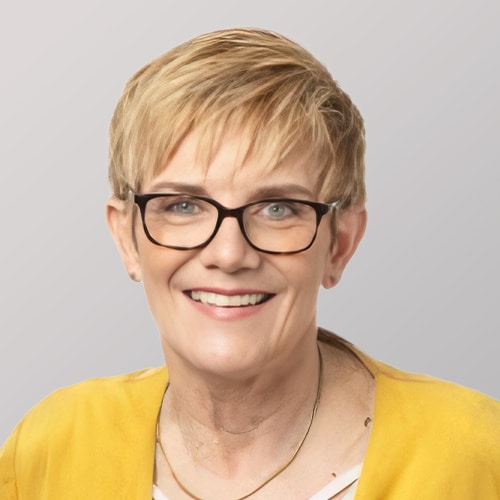
Carol Cooke AM PLY is a 3-time gold medal Paralympian and 9-time World Champion in para-cycling. Throughout her sporting career, Carol has competed as a cyclist, swimmer and rower and will be competing in Australia’s para-curling team in Finland in November 2026.